The best heavy eye cream for deep crow's feet and under-eye hollows is a formulation that synergises high-potency retinoids with biomimetic peptides and occlusive lipids. For deep periorbital wrinkles (crow's feet), clinical evidence strongly supports encapsulated retinol or retinaldehyde, which stimulates collagen synthesis and reorganises dermal fibres to reduce wrinkle depth [1]. Because the periorbital skin is significantly thinner and lacks sebaceous glands, a 'heavy' texture provided by ceramides, cholesterol, and fatty acids is essential to restore the skin barrier and prevent trans-epidermal water loss, which often exacerbates the appearance of fine lines [2].
To address under-eye hollows (tear trough deformity), topical creams have limitations compared to injectable fillers, yet specific ingredients can provide a visible improvement. Formulations containing acetyl hexapeptide-8 or palmitoyl pentapeptide-4 work to improve skin density and elasticity, while high-molecular-weight hyaluronic acid and glycerin provide an immediate 'plumping' effect by drawing moisture into the stratum corneum [3]. When these are delivered in a rich, anhydrous or water-in-oil emulsion, they create an occlusive seal that maximises the penetration of actives, making the hollows appear less pronounced through improved dermal hydration and light reflection [4].
The periorbital region is unique due to its anatomical vulnerability; the skin here is approximately 0.5mm thick, compared to 2-3mm on the rest of the face, making it the first area to exhibit signs of photo-ageing and structural volume loss [1]. Crow's feet are primarily dynamic wrinkles caused by the contraction of the orbicularis oculi muscle, which eventually become static due to the degradation of type I collagen and elastin [5].
Under-eye hollows, or the tear trough deformity, result from a combination of orbital fat pad herniation, maxillary bone resorption, and the thinning of the overlying soft tissue [4]. While topical treatments cannot reposition fat pads or alter bone structure, they can significantly improve the skin's refractive index and structural integrity. Evidence-based skincare focuses on 'biorevitalisation'—using active molecules to signal the skin to repair its own extracellular matrix, thereby thickening the dermis to better conceal the underlying vascularity and structural transitions [2].
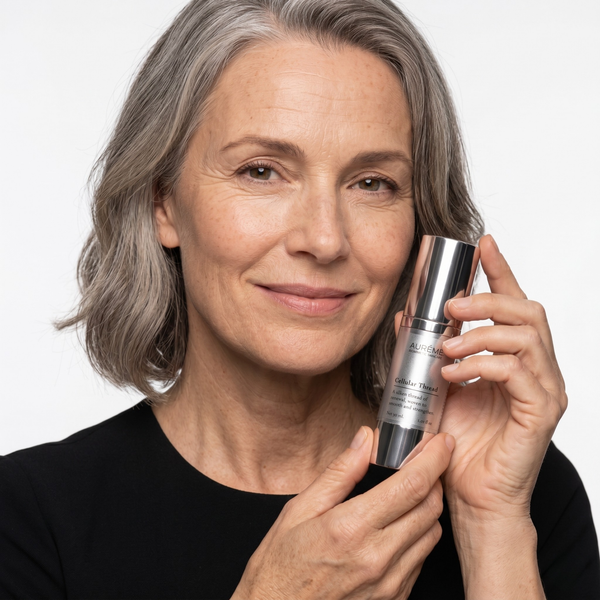
For those looking to address the delicate nature of the periorbital area, our Cellular Crème was formulated as a rich yet weightless peptide moisturiser that focuses on deep hydration and barrier sealing to help preserve skin suppleness. Some of our customers find that layering this over a specialised treatment like Cellular Thread, which includes a targeted Cellular Peptide Complex and antioxidant-rich Kakadu Plum, helps to further support firmness and the appearance of skin longevity.
FAQ
Can eye creams actually fix hollows caused by volume loss?
Topical creams cannot replace lost subcutaneous fat or bone, but they can mitigate the appearance of hollows by increasing epidermal thickness and dermal hydration. Ingredients like Caffeine and Vitamin K improve microcirculation to reduce the dark shadows that often accompany hollows, while Neocollagenesis-inducing agents like peptides help reinforce the skin's 'scaffold', making the transition from the cheek to the under-eye appear smoother [3][6].
Why is a 'heavy' cream better than a lightweight serum for crow's feet?
Heavy creams typically utilise a water-in-oil formulation or high concentrations of occlusives like petrolatum, shea butter, or squalane. This is superior for deep crow's feet because it creates a physical barrier that facilitates 'slugging'—deeply hydrating the parched periorbital tissue. This prolonged hydration softens the keratinised surface of the skin, making deep wrinkles appear less sharp and preventing the 'crinkling' effect seen with lighter gels [2][5].
Are retinoids safe for the delicate under-eye area?
Retinoids are safe and highly effective for the under-eye area when formulated specifically for periorbital use. Modern stabilised or encapsulated retinol reduces the risk of irritation (retinoid dermatitis). Studies show that consistent use of low-dose topical retinoids increases mucosal glycosaminoglycans and collagen, which are critical for treating the thinning skin that leads to crow's feet [1][4].
References:
[1] Zasada M, et al. Retinoids: active molecules influencing skin structure formation in cosmetic and dermatological treatments. Postepy Dermatol Alergol. 2019;36(4):392-397. doi:10.5114/ada.2019.87443.
[2] Draelos ZD. The science behind skin care: Moisturizers. J Cosmet Dermatol. 2018;17(2):138-144. doi:10.1111/jocd.12490.
[3] Schagen SK. Topical Peptide Treatments with Effective Anti-Aging Results. Cosmetics. 2017;4(2):16. doi:10.3390/cosmetics4020016.
[4] Goldberg DJ. Periorbital rejuvenation: A review of non-invasive techniques. J Clin Aesthet Dermatol. 2020;13(1):18-22.
[5] Lim SH, et al. Quantitative analysis of the effect of eyelid skin thickness on crow's feet wrinkles. Skin Res Technol. 2021;27(4):556-562. doi:10.1111/srt.12984.
[6] Vrcek I, et al. Infraorbital dark circles: A review of pathogenesis and treatment options. J Cutan Aesthet Surg. 2016;9(2):65-72. doi:10.4103/0974-2077.184046.
Medical Disclaimer: This article is for educational purposes only and does not constitute medical advice. Always consult a qualified healthcare professional before starting any new skincare regimen. Content reviewed by a biomedical scientist.