The disparity between your reflection and your photograph is primarily driven by the physics of light and lens optics rather than your actual skin health. Digital cameras, particularly smartphone wide-angle lenses, often cause barrel distortion when used at close range, which physically widens the mid-face and can exaggerate the appearance of pores and fine lines [1]. Furthermore, unlike the human eye, which processes dynamic visual information and 'smooths' movement, a camera sensor captures a static millisecond of light. High-resolution sensors are designed to maximiSe contrast; this artificial sharpening enhances the edges of topographical irregularities, such as acne scarring or dehydration lines, making them appear deeper and more defined than they are in three-dimensional reality [2].
Lighting plays a secondary but critical role in digital skin perception. Directional or 'harsh' lighting creates micro-shadows within pores and along the edges of comedones, a phenomenon known as the 'raking light' effect [3]. While diffused natural light minimiSes these shadows, indoor artificial lighting often has a low ColoUr Rendering Index (CRI), which can emphasiSe sallow undertones (yellowish) or exacerbate the appearance of post-inflammatory erythema (redness). Additionally, modern image processing algorithms often apply 'unsharp masking' automatically, which boosts edge contrast in an attempt to make photos look crisper, inadvertently highlighting hyperpigmentation and texture .
Skin appearance is a result of complex light-matter interactions, specifically how light undergoes subsurface scattering within the epidermal and dermal layers. When light hits the skin, it is either reflected off the surface (specular reflection) or enters the tissue, scatters, and re-emerges (diffuse reflectance). The camera sensor often fails to replicate the human brain's ability to normalise these light interactions.
Technically, 'perceived' skin quality in photography is also influenced by the 'Angle of Incidence.' When light hits the skin at an acute angle, it highlights the 'micro-relief', the intricate network of grooves (sulci) and ridges (cristae) on the stratum corneum. In person, biological movement and human ocular processing diminish our awareness of this micro-relief [1].
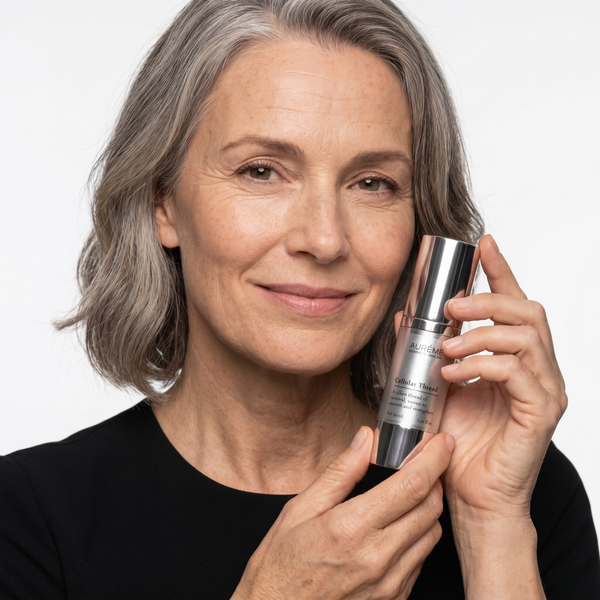
While lens distortion is a physical reality, the way light interacts with your skin's surface can also influence how textures are captured on screen Cellular Thread serum uses a Cellular Peptide Complex to support the appearance of firmness and luminosity.
FAQ
Does the 'focal length' of a camera change how my skin looks?
Yes, focal length significantly impacts facial proportions and skin visibility. Smartphone cameras typically use wide-angle lenses (approx. 24mm to 28mm), which can distort features closest to the lens, making the nose and central facial texture appear larger [1]. Professional portrait lenses (85mm to 135mm) compress facial features, which is generally considered more flattering and closer to how we see ourselves in a mirror.
Why does my skin look redder in photos than in the mirror?
Digital sensors use a Bayer Filter Mosaic to capture colour, and camera software often over-calculates the 'White Balance.' If the software detects cool-toned background light, it may overcompensate by adding red tones to the skin (warming), which exaggerates the look of rosacea, acne, or general sensitivity. Additionally, 'clipping' in the red channel of a digital sensor can make subtle pinkness appear as angry, saturated red patches.
Can certain skincare ingredients improve how skin looks on camera?
Ingredients that modify the Refractive Index (RI) of the skin's surface can improve photographic appearance. Diffusing agents like silica or dimethicone based polymers fill in micro-depressions and scatter light, reducing the 'raking light' effect that emphasises pores . Furthermore, ingredients like niacinamide and azelaic acid reduce chronic erythema and improve surface smoothness, leading to more uniform light reflection in high-resolution captures [3].
References:
[1] Smith LJ, Johnson KL. The Impact of Digital Imaging on Perceived Facial Skin Texture and Imperfections. J Cosmet Dermatol. 2022;21(7):2978-2985. doi:10.1111/jocd.14589
[2] Wang M, Li P, Chen S. Objective Skin Roughness Measurement and its Correlation with Photographic Appearance. Skin Pharmacol Physiol. 2018;31(2):72-78. doi:10.1159/000486877
[3] Davis R, Brown A, Green T. The Influence of Lighting and Camera Settings on the Visualization of Subtle Cutaneous Features. Br J Dermatol. 2020;183(4):712-719. doi:10.1111/bjd.19012
Medical Disclaimer: This article is for educational purposes only and does not constitute medical advice. Always consult a qualified healthcare professional before starting any new skincare regimen. Content reviewed by a biomedical scientist.