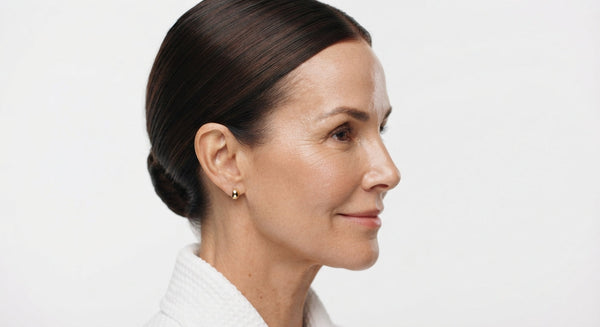
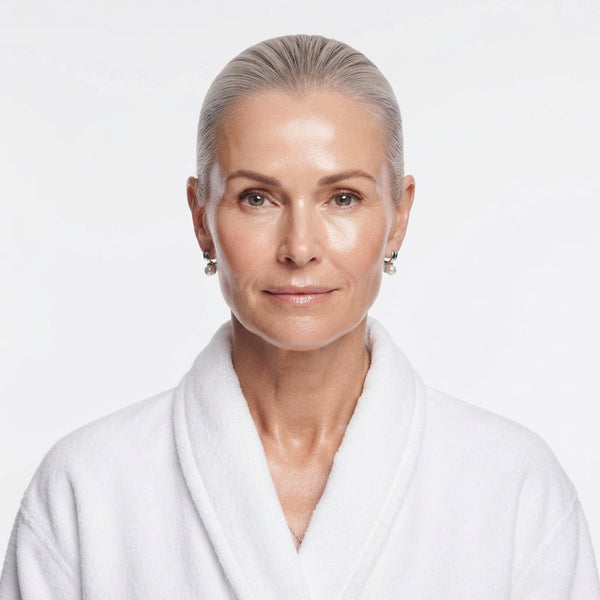
To effectively improve the appearance of crepey skin on the neck and chest, clinical evidence points towards a multi-modality approach focusing on dermal thickening and collagen synthesis. Topical retinoids (Retinol or Tretinoin) remain the gold standard, as they stimulate the production of glycosaminoglycans and collagen, which increases skin density and reduces the 'crinkled' texture associated with atrophy [1]. Because the skin on the neck is thinner and has fewer sebaceous glands than facial skin, these should be introduced gradually to avoid irritation while still achieving cellular turnover [2].
Beyond retinoids, high-molecular-weight hyaluronic acid and specialised peptides, such as palmitoyl pentapeptide-4, are essential for immediate and long-term hydration and structural support. These ingredients work by drawing moisture into the epidermis to plump the surface and signalling fibroblasts to produce new extracellular matrix components [3]. Furthermore, daily application of a broad-spectrum SPF 50+ is non-negotiable, as UV-induced elastin degradation (solar elastosis) is the primary driver of the thin, fragile texture characteristic of the décolletage in the Australian climate [4].
Crepey skin, scientifically referred to as cutaneous atrophy, differs from deep expression wrinkles. It is characterised by a thinning of both the epidermis and dermis, alongside a significant loss of elastin and collagen fibres that provide the skin's 'snap-back' resilience [2]. In the Australian context, chronic solar radiation accelerates the breakdown of these structural proteins through the upregulation of matrix metalloproteinases (MMPs), which enzymatically digest the dermal matrix faster than the body can repair it [4].
Histologically, the neck and chest area are particularly vulnerable due to a lower density of hair follicles and oil glands compared to the face, leading to a compromised lipid barrier and slower healing rates [5]. Effective treatment requires ingredients that not only stimulate protein production but also restore the barrier function to prevent transepidermal water loss, which exacerbates the appearance of fine, paper-like lines.
For those seeking to support the skin’s structural integrity in these delicate areas, AUREME formulated Cellular Thread with a specialised peptide complex to assist in maintaining a firmer, more resilient appearance. To further support the moisture barrier and minimise the look of atrophy, following with a rich treatment like Cellular Crème provides the deep hydration and suppleness necessary to help smooth the visible texture of the neck and chest.
FAQ
Can moisturiser alone fix crepey skin?
While standard moisturisers can temporarily improve the appearance of crepey skin by hydrating the stratum corneum, they do not address the underlying dermal thinning. Effective treatments must include 'actives' like niacinamide or peptides that cross the basement membrane to influence cellular behaviour [3]. Without these, the 'plumping' effect is purely superficial and will disappear once the product is washed off [5].
Is the skin on the neck different from the face?
Yes, the skin on the neck and chest is significantly thinner and contains fewer melanocytes and sebaceous glands than facial skin [2]. This makes the area more prone to dehydration and environmental damage, while also being more sensitive to potent ingredients like Retin-A, requiring a more cautious, buffered approach to active skincare [1].
Do collagen supplements help with chest wrinkles?
Recent clinical trials suggest that oral ingestion of bioactive collagen peptides may improve skin elasticity and hydration by stimulating the body's own collagen production pathways [6]. However, these results are most effective when combined with topical sun protection to prevent the newly formed collagen from being destroyed by UV radiation [4].
References:
[1] Zasada M, Budzisz E. Retinoids: active molecules influencing skin structure formation in cosmetic and dermatological treatments. Postepy Dermatol Alergol. 2019;36(4):392-397. doi:10.5114/ada.2019.87443.
[2] Humphreys TR, et al. The Biology of the Neck and Décolletage. Journal of Clinical and Aesthetic Dermatology. 2021;14(7):22-28.
[3] Schagen SK. Topical Peptide Treatments with Effective Anti-Aging Results. Cosmetics. 2017;4(2):16. doi:10.3390/cosmetics4020016.
[4] Passeron T, et al. Sunscreen photoprotection and modern photobiology. Journal of the American Academy of Dermatology. 2020;82(5):1035-1047. doi:10.1016/j.jaad.2019.12.066.
[5] Papakonstantinou E, et al. Hyaluronic acid: A key molecule in skin aging. Dermato-Endocrinology. 2012;4(3):253-258. doi:10.4161/derm.21923.
[6] Choi FD, et al. Oral Collagen Supplementation: A Systematic Review of Dermatological Applications. Journal of Drugs in Dermatology. 2019;18(1):9-16.